Understanding Liability in Multi-Vehicle Accident Claims
Determining multi-vehicle accident liability is often more complicated than identifying fault in a two-car crash. In Indiana, responsibility may be shared among multiple drivers, and each party’s actions must be evaluated to determine how the chain of events occurred and who may be responsible for resulting injuries and damages.
Why Multi-Car Accidents Are Among the Most Complex Injury Cases
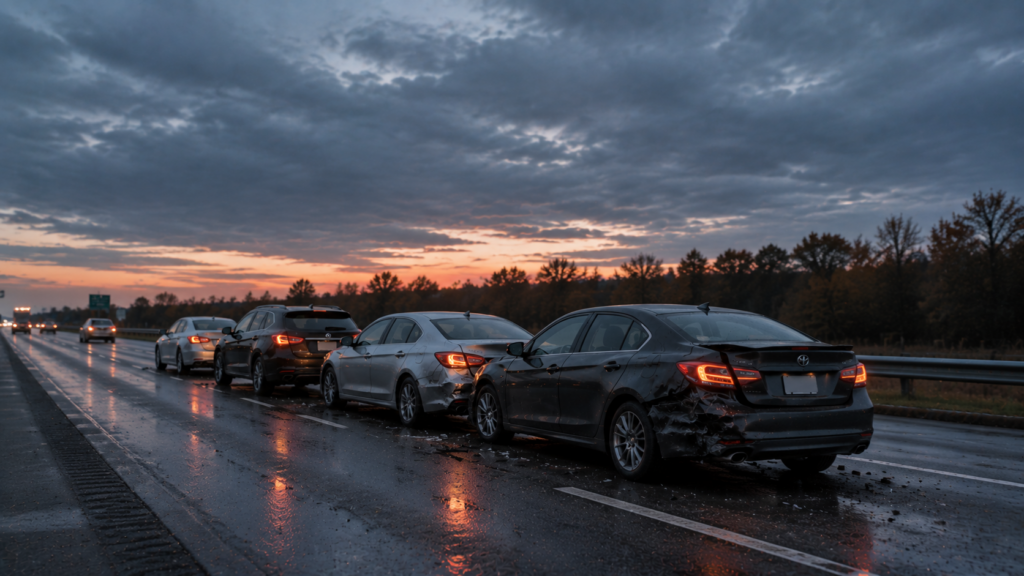
A typical rear-end collision may involve only two drivers and two insurance companies. A multi-car pileup, however, can involve several vehicles, multiple insurance carriers, conflicting witness accounts, and competing theories about who caused the crash.
These accidents often occur on highways, during poor weather conditions, or in heavy traffic. One driver’s mistake may trigger a chain reaction involving numerous vehicles, making it difficult to determine exactly where the fault began and how responsibility should be divided.
For injured victims, understanding how liability is assigned can be critical because compensation often depends on identifying every responsible party and navigating multiple insurance claims. If you were injured in a multi-vehicle collision in Indiana, knowing how these cases are investigated can help you better understand your legal options.
Key Takeaways
- Multi-vehicle accident liability often involves multiple responsible parties rather than a single at-fault driver.
- Indiana’s comparative fault system allows liability to be divided among drivers according to their actions.
- Insurance disputes are common because several carriers may be involved.
- Evidence such as crash reports, vehicle damage, witness statements, and expert analysis often plays a crucial role.
- Early investigation can help preserve important evidence and strengthen a pileup crash claim.
What Is a Multi-Car Pileup Accident?
A multi-car accident generally involves three or more vehicles.
These crashes can occur in many ways, including:
- Chain-reaction rear-end collisions
- Highway pileups
- Multi-vehicle intersection crashes
- Weather-related accidents
- Commercial vehicle incidents
Chain-Reaction Crashes
One of the most common types of multi-vehicle accidents is a chain-reaction collision.
For example:
- Driver A stops suddenly.
- Driver B strikes Driver A.
- Driver C hits Driver B.
- Additional vehicles become involved.
In these situations, determining fault is not always as simple as identifying the last vehicle in the chain.
Highway Pileups
High-speed crashes often create additional complications because multiple impacts may occur within seconds.
Visibility issues, road conditions, and driver reactions can all influence liability.
How Is Fault Determined in a Chain-Reaction Crash?
Determining chain-reaction accident fault requires a detailed investigation of how the collision unfolded.
Identifying the Initial Event
Investigators often begin by determining what triggered the sequence of collisions.
Questions may include:
- Did a driver stop suddenly?
- Was a vehicle speeding?
- Did someone fail to maintain a safe following distance?
- Were weather conditions a factor?
Evaluating Each Driver’s Conduct
Every driver’s actions are examined separately.
Relevant factors may include:
- Speed
- Following distance
- Distraction
- Impairment
- Lane changes
- Failure to react appropriately
Understanding Multiple Impacts
In many pileups, a vehicle may be struck multiple times by different drivers.
This can complicate efforts to determine:
- Which impact caused specific injuries
- Which driver bears responsibility
- How damages should be allocated
Can Multiple Drivers Be Liable?
Yes.
In fact, multiple-driver liability is common in multi-vehicle collisions.
Shared Responsibility
Several drivers may contribute to the same accident through separate acts of negligence.
Examples may include:
- One driver following too closely
- Another driver speeding
- A third driver making an unsafe lane change
Each party’s conduct may contribute to the overall collision.
Non-Driver Liability
In some cases, additional parties may share responsibility, including:
- Trucking companies
- Vehicle manufacturers
- Government entities responsible for road maintenance
- Commercial vehicle operators
Identifying all potentially responsible parties is often critical to maximizing compensation.
How Does Indiana Comparative Fault Law Apply?
Indiana follows a modified comparative fault system.
This system plays an important role in multi-vehicle accident liability cases.
Allocation of Fault
Each party receives a percentage of responsibility based on their actions.
For example:
- Driver A: 50%
- Driver B: 30%
- Driver C: 20%
Compensation may be adjusted according to each party’s share of fault.
The 51% Rule
Under Indiana law, an injured person generally cannot recover damages if they are found to be more than 50% responsible for the accident.
This makes fault determinations especially important in complex multi-vehicle collisions.
Why Comparative Fault Disputes Matter
Insurance companies frequently dispute fault percentages because liability allocations directly affect how much compensation must be paid.
What Insurance Challenges Arise in Multi-Car Accidents?
Insurance issues often become one of the most complicated aspects of a pileup crash claim.
Multiple Insurance Companies
Each driver may have a separate insurer.
As a result, accident victims may need to deal with:
- Multiple adjusters
- Multiple investigations
- Competing liability positions
Conflicting Fault Determinations
Different insurers may assign fault differently.
One company may blame Driver A while another focuses on Driver B.
These disagreements can delay claim resolution.
Policy Limits Issues
Severe pileups often involve substantial injuries and damages.
Available insurance limits may be insufficient to fully compensate all victims.
When this occurs, identifying additional sources of coverage becomes especially important.
Commercial Vehicle Involvement
If a commercial truck or company vehicle is involved, additional insurance policies may be available.
What Evidence Helps Establish Liability?
Evidence is often the key to resolving disputes in multi-vehicle accident cases.
Police Reports
Accident reports frequently contain:
- Driver statements
- Witness information
- Officer observations
- Citations issued
Photographs and Video
Visual evidence may capture:
- Vehicle positions
- Road conditions
- Skid marks
- Traffic controls
Dashcam footage can be especially valuable.
Witness Statements
Independent witnesses may provide insight into:
- Driver behavior
- Traffic conditions
- The sequence of impacts
Vehicle Damage Analysis
Damage patterns often help accident reconstruction experts determine:
- Impact points
- Vehicle movements
- Collision sequence
Event Data Recorders
Many modern vehicles contain electronic data that may record:
- Speed
- Braking activity
- Steering inputs
This information can help clarify disputed facts.
How Are Injuries Evaluated in Multi-Vehicle Claims?
Determining injury causation can become particularly complicated in pileup accidents.
Multiple Impacts
Victims may experience:
- Initial impact injuries
- Secondary impact injuries
- Side-impact injuries
- Rear-end collision injuries
Medical Documentation
Medical records help establish:
- Injury severity
- Treatment requirements
- Long-term prognosis
Prompt medical evaluation remains important even when injuries seem minor.
Expert Testimony
Medical experts and accident reconstruction specialists may help explain how specific injuries occurred.
What Should You Do After a Multi-Car Accident?
The actions you take immediately after a collision can significantly affect your claim.
Seek Medical Attention
Always prioritize health and safety.
Some injuries may not become apparent immediately.
Report the Accident
Law enforcement documentation can be valuable in establishing liability.
Preserve Evidence
Take photographs and gather information regarding:
- Drivers
- Witnesses
- Insurance providers
Avoid Admitting Fault
Because liability often remains unclear in multi-vehicle accidents, avoid making assumptions regarding responsibility.
Contact an Attorney
Complex cases often benefit from early legal guidance.
When Should You Contact a Lawyer?
You should consider speaking with an attorney if:
- Multiple vehicles were involved
- Liability is disputed
- Serious injuries occurred
- Commercial vehicles were involved
- Insurance companies are assigning blame unfairly
An attorney can help coordinate investigations, preserve evidence, and pursue compensation from all responsible parties.
Expert Tips
- Obtain contact and insurance information from all involved drivers whenever possible.
- Take extensive photographs of vehicle positions before vehicles are moved, if it is safe to do so.
- Preserve dashcam footage immediately because recordings may be overwritten.
- Seek medical evaluation promptly, even if injuries seem minor at first.
- Consult an attorney early if fault is disputed or multiple insurers are involved.
Frequently Asked Questions
Who is usually at fault in a chain-reaction accident?
There is no automatic rule. Fault depends on the actions of each driver and the circumstances surrounding the collision.
Can more than one driver be responsible?
Yes. Multiple drivers frequently share responsibility in multi-vehicle accidents.
What if a truck caused the pileup?
The truck driver, trucking company, maintenance provider, or other parties may share liability depending on the facts.
How does Indiana comparative fault affect compensation?
Compensation may be reduced according to an injured person’s percentage of fault, and recovery is generally barred if fault exceeds 50%.
What if multiple insurance companies disagree about fault?
Disputes among insurers are common. Additional investigation and legal representation may help resolve liability issues.
References
Indiana Department of Insurance
https://www.in.gov/idoi
Indiana Judicial Branch
https://www.in.gov/courts
Indiana General Assembly
https://iga.in.gov
National Highway Traffic Safety Administration
https://www.nhtsa.gov
Federal Highway Administration
https://highways.dot.gov
Navigating Liability After a Complex Multi-Vehicle Collision
Multi-car pileups often create complicated questions about fault, insurance coverage, and compensation. Unlike a simple two-car collision, responsibility may be divided among several drivers, commercial entities, or other parties. A thorough investigation is often necessary to determine exactly how the accident occurred and who should be held accountable.
If you were injured in a collision involving multiple vehicles, Isaacs & Isaacs Law Firm can help investigate the accident, identify all responsible parties, and pursue your pileup crash claim. Contact our team today for a free consultation.