
Settling a truck accident claim in Indiana usually takes six months to two years from the crash. Claims with clear fault and minor injuries can wrap up in a few months, while serious injuries, several insurers or a fight over blame push the timeline toward two years or past it.
This article covers the settlement side only: when a claim can resolve without a trial and when the money reaches your hands. If your case ends up in court, the lawsuit stages run on a separate timeline.
Key Takeaways
- Most Indiana truck accident claims settle within six months to two years. Minor injuries with clear fault can resolve in a few months, while serious injuries or disputed fault take longer.
- A claim usually can’t be valued until you reach maximum medical improvement, and liens and disbursement add time after a deal is reached.
- Settlement talks don’t pause Indiana’s two-year deadline to file a lawsuit, so have your lawyer track the filing date from day one.
Short Answer: How Long Does It Take to Settle a Truck Accident Claim in Indiana?
Law firms that handle trucking cases tend to give similar ranges. Stracci Law Group says most truck claims settle within six months to two years, and CSG Trial Lawyers puts the typical window at six to 24 months from the incident date. Indiana-specific figures are scarcer, and the Indiana pages that exist mostly cover car crashes. Truck claims run longer than car claims because they involve bigger policies, more parties and more evidence.
Your own Indiana truck accident settlement timeline will land somewhere in that range depending on two things: how badly you were hurt and how much the other side disputes.
Minor Injuries and Clear Fault: As Little as a Few Months
When the truck driver clearly caused the crash, your injuries heal fully, and the insurer cooperates, a settlement can come together quickly. DeMayo Law Offices says a few months is possible for these cases, and Lane Brown puts straightforward claims with cooperative insurers at six to nine months.
Even here, you cannot settle until your treatment is done and your bills are totaled. That is why “a few months” rarely means a few weeks.
Serious Injuries or Disputed Fault: One to Two Years or More
Broken bones that need surgery, spinal injuries, brain injuries and anything that leaves lasting limits take longer. Your doctors need time to see how you recover, and the insurer needs time to fight over what your future care will cost.
If the trucking company denies its driver was at fault, or points at another driver, a maintenance shop or you, expect the longer end of the range. Some claims in this category cannot settle at all and move into a lawsuit.
The Truck Accident Settlement Process in Indiana, Step by Step
The truck accident settlement process in Indiana follows the same basic order in most cases. Some steps overlap, and a few can stall the whole claim. Here is where the time goes.
Your Medical Recovery Sets the Pace: Maximum Medical Improvement
Maximum medical improvement (MMI) is the point where your doctors say your condition has stabilized or improved as much as it is likely to. It does not mean you are fully healed, and treatment may continue. It means your doctors can now predict what your recovery will look like and what care you will need later.
MMI drives settlement timing because a claim cannot be valued until that outlook is clear. Future surgeries, therapy, medication and lost earning ability all feed into the number. For a minor injury, MMI may arrive in weeks. For a serious one, it can take a year or longer.
Investigating the Crash and Preserving Trucking Company Evidence
While you treat, your lawyer investigates. One timeline from Stracci Law Group puts the initial investigation and evidence-gathering phase at roughly two to eight weeks, though a complex crash can keep producing work well past that.
Speed matters here. An Indiana firm, Emerson Law, warns that trucking companies begin destroying evidence early. Your lawyer typically sends a preservation letter right away, demanding the company keep items such as:
- Driver logs and hours-of-service records
- Electronic data from the truck’s onboard systems
- Maintenance and inspection records
- Driver hiring, training and drug-testing files
- Dashcam footage, if the truck had a camera
This work happens in the background and does not hold up your settlement by itself. It does decide how strong your position is when talks begin.
Building and Sending the Settlement Demand
Once you reach MMI, your lawyer assembles the demand package. It includes your medical records and bills, proof of lost income, a projection of future costs, photos, evidence of fault and a written account of how the crash changed your life. The package ends with a specific dollar amount.
Gathering records from several providers is often the slowest part. Hospitals and clinics can take weeks to respond to requests, and a missing record can weaken the demand. A complete package sent once beats a partial one you have to supplement.
The Insurer’s Response and Settlement Negotiations
The insurer reviews the demand, and then the back-and-forth begins. Adjusters often respond with a first offer well below the demand and cite weak points such as gaps in treatment, pre-existing conditions or shared fault. Your lawyer answers each point with records and evidence and counters.
Negotiations can finish in a few rounds or drag across months. Insurers sometimes slow-walk a claim hoping you will accept less to get money sooner. Knowing what a fair offer looks like, and when to reject one, is a big part of what shortens or lengthens this stage.
Signing the Release and Resolving Liens
When both sides agree on a number, the insurer sends a release. Signing it ends your claim for good, so your lawyer reads it for broad language that could affect other claims you might have, such as against another party.
Before any money goes to you, the people who paid or fronted your medical care get paid out of the settlement. That is covered in more detail below, because it is one of the most common causes of delay after a deal is struck.
When the Money Actually Reaches You
Many people searching “when will I get my truck accident settlement Indiana” assume payment follows the handshake. It does not. After you sign the release, the insurer issues payment, usually to your lawyer’s trust account. The funds have to clear, and liens, case costs and attorney fees come out before you receive the balance.
How fast that goes depends on the insurer’s payment process and how many liens need to be settled. A claim with one health insurer and no hospital lien disburses far faster than one with several creditors negotiating their share. Ask your lawyer for a disbursement estimate before you sign.
Why Settling Before Your Treatment Ends Can Cost You
Early offers can be tempting when you are missing work and bills are stacking up. An insurer that offers a quick payout is betting you will take it before the full cost of your injuries is known. Our own firm’s guidance on serious injuries makes the same point: settling too early can leave out future medical care, lost earning capacity and permanent limitations.
The reason is simple. A settlement is final. Once you sign a release, you give up the right to come back for more, even if surgery turns out to be necessary six months later or your condition worsens.
Here is how that plays out. Say you accept an offer while your back is still in treatment, and your doctor later recommends a procedure. The insurer owes you nothing further, and you carry that bill yourself.
That does not mean you should never settle early. If your injuries were minor and you have fully recovered, an early resolution can make sense. The question is whether your doctors can tell you, with reasonable confidence, what your injuries will cost over time.
What Slows Down an Indiana Truck Accident Claim
Beyond medical recovery, four things regularly stretch an Indiana truck accident settlement timeline.
Multiple Defendants and Multiple Insurance Policies
A car crash usually has one at-fault driver and one policy. A truck crash can involve the driver, the trucking company, the owner of the trailer, a cargo loader, a broker or a maintenance contractor. Each may have its own insurer, and each insurer may blame the others.
Policy size adds to this. Federal rules require for-hire interstate carriers hauling non-hazardous freight to carry at least $750,000 in liability coverage, and the minimum is $5 million for certain hazardous cargo, according to the Federal Motor Carrier Safety Administration. Bigger policies mean insurers fight harder and review claims more carefully, which takes longer.
Hospital Liens and Health Insurer Reimbursement Claims
Indiana’s hospital lien statute, Indiana Code chapter 32-33-4, lets a hospital claim payment for your care directly out of your settlement. Your health insurer may also demand repayment for what it covered. Each of these claims has to be verified, and often negotiated down, before disbursement.
The statute includes a provision that protects the patient’s share when a settlement would otherwise leave you with less than 20 percent. How that applies to your case is something your lawyer should walk you through. Sorting out liens early, rather than after the deal is made, keeps the final payout from stalling.
Disputes Over Fault or the Cost of Future Care
Insurers contest two things most often: who caused the crash and what your future care is worth. Under Indiana’s comparative fault rules, any share of blame assigned to you reduces your recovery, and enough of it can bar your claim. So the insurer has a reason to push for it.
Disagreements over future care usually come down to competing medical opinions. Your lawyer may need a treating doctor or an outside specialist to put the long-term costs in writing, which adds time but strengthens your position.
Extra Steps When a Claim Involves a Minor or an Estate
When the injured person is a child, or when a crash victim has died and the claim belongs to their estate, a court often has to review and approve the settlement before it becomes final. That adds paperwork, a hearing in some cases and waiting for the court’s calendar.
The specific requirements depend on the type of claim and the county, so ask your lawyer which steps apply to you and how long they usually take.
Can an Indiana Truck Accident Claim Settle Without a Lawsuit?
Yes. Many cases settle during the insurance claim, before anyone files in court. An Indiana truck accident claim without a lawsuit is often the fastest path, since it skips the court schedule entirely. It works best when fault is clear, the injuries are well documented and the insurer is willing to negotiate in good faith.
Most Indiana personal injury cases settle before trial, and negotiations often continue even after a lawsuit is filed. Filing does not mean you are headed to a jury. It sometimes gives a reluctant insurer a reason to take the claim seriously.
If the insurer denies liability, lowballs a serious injury or refuses to move, a lawsuit may be the only way to get fair value. At that point, your timeline shifts from the settlement track to the litigation track, with its own stages and delays.
Settlement Talks Do Not Pause Indiana’s Two-Year Filing Deadline
Indiana Code § 34-11-2-4 gives you two years to file a personal injury lawsuit, and the clock generally starts on the date of the accident. Negotiating with an insurer does not stop or extend it. An adjuster can keep talks going for months and then run out the clock.
If the deadline passes without a filed lawsuit, you can lose your right to recover, no matter how strong your claim was. That makes the timeline a balancing act: you want to settle only after you know the full value of your injuries, but not so late that you have no time to sue if talks fail.
A good rule is to have your lawyer track the filing date from day one. If negotiations are still unresolved as it approaches, your lawyer can file to protect your claim and keep talking while the suit is pending.
How an Indiana Truck Accident Lawyer Keeps Your Claim Moving
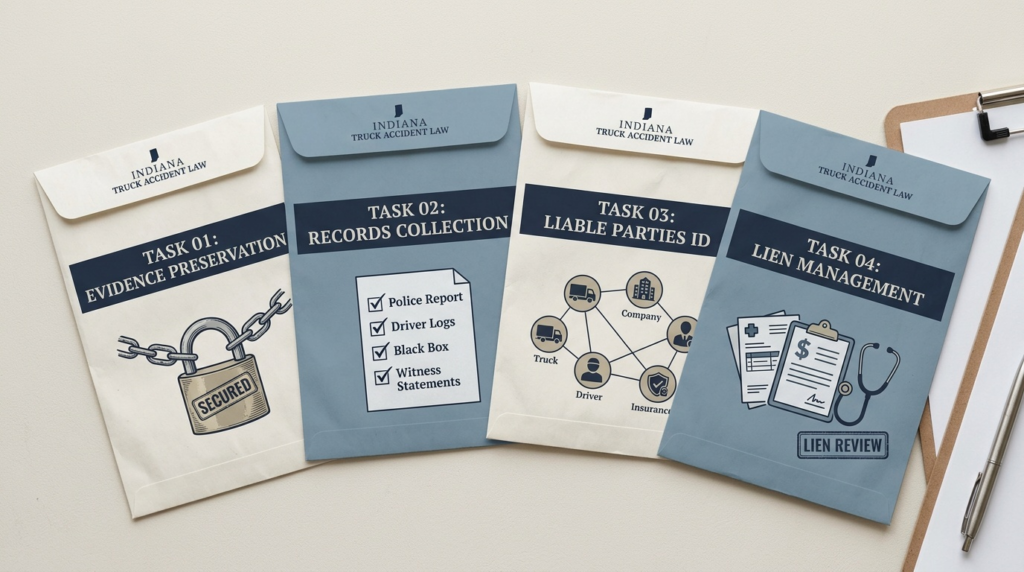
A truck accident lawyer in Indiana cannot make your doctors reach MMI faster, and no honest lawyer will promise a fixed date. What a lawyer can do is remove the avoidable delays: sending preservation letters before evidence disappears, collecting records in one pass, identifying every liable party and policy early, and handling liens while negotiations are still underway.
A lawyer also helps you judge timing. Knowing whether an offer reflects your full future costs, and whether waiting will improve it, is hard to do alone against a trucking insurer’s claims team. And your lawyer watches the two-year deadline so it never becomes your problem.
Frequently Asked Questions
How long does it take to settle a truck accident claim in Indiana?
Most truck accident claims settle within six months to two years from the crash. Claims with clear fault and minor injuries can resolve in a few months, while serious injuries, several insurers or disputes over fault can push the timeline past two years.
Why can’t I settle before my treatment is finished?
A claim can’t be valued until your doctors know what your recovery will look like. Once you sign a release, you can’t come back for more money, even if you later need surgery or your condition gets worse.
When will I get my truck accident settlement money in Indiana?
After you sign the release, the insurer usually pays into your lawyer’s trust account. Liens, case costs and attorney fees come out before you receive the balance, so ask your lawyer for a disbursement estimate before you sign.
Can an Indiana truck accident claim settle without a lawsuit?
Yes. Many claims settle during the insurance claim, before anything is filed in court. This works best when fault is clear, the injuries are well documented and the insurer negotiates in good faith.
Do settlement talks extend Indiana’s two-year filing deadline?
No. Under Indiana Code § 34-11-2-4, you generally have two years from the accident to file a personal injury lawsuit, and negotiating with an insurer does not stop that clock.