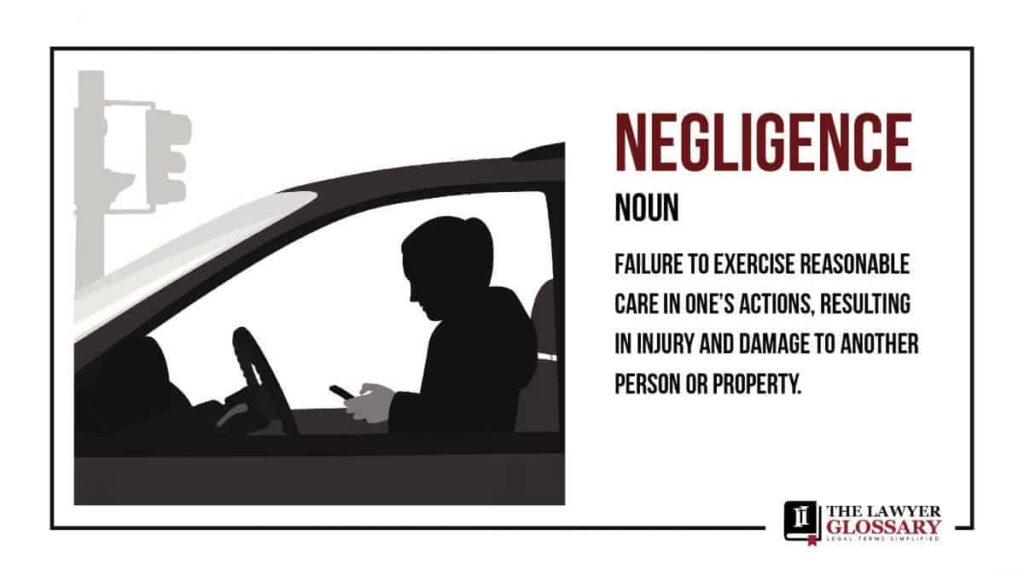
 What Does Negligence Mean in Daily Life?
Examples of negligence in everyday life could include:
- Violating any number of traffic laws including texting while driving, speeding and DUI
- Ignoring or delaying needed vehicle maintenance
- A café owner mopping floors but forgetting to put out a “wet floor” sign
- A dog owner overlooking leash laws
- Miscalculations in financial and contractual dealings
- Improper land surveys
- A surgeon operating on the incorrect patient
Watch This 2-minute Video Defining Negligence:

Injured in an Accident?
Get a free case review by calling The Hammer Now.
 (800) 333-9999
Four Elements of Negligence That Must Be Proven
In order to prove negligence in Civil Law, you must show that all four elements of negligence were contributing causes to your injuries. For this example, we’ll use a collision involving a large commercial 18-wheeler truck:
- Somebody owed you a duty of ordinary care
In a trucking collision, it could be the trucking company or the driver that owes people on the road a duty to drive safely and reasonably. - They breached that duty of ordinary care
A breach could include many different acts, or failing to do something important like maintain the truck according to FMCSA standards or the driver getting enough rest. Poor maintenance of the truck, speeding, or driver fatigue are all negligent acts. - The breach of that duty of care caused your injury
You were injured in the truck collision which was caused by the negligent driver or trucking company, or your property was destroyed, or both. - The harm caused monetary losses
The crash caused your injuries resulting in loss of income, disability, and/or emotional and physical pain and suffering.
1-min Audio Clip With Attorney Darryl Isaacs Discussing Negligence Meaning and Types
Other common forms of Negligence used:
- Negligent
- Acting negligently
Popular Related Terms:
Criminal Negligence Definition
When a criminal act occurs, elements of negligence can play a part. If a driver was under the influence of alcohol and hits and kills someone, they may have committed a crime and simultaneously acted negligently by ignoring traffic laws. This could be considered a criminally negligent homicide.
Gross Negligence Definition
Unlike an oversight or failure to provide a duty of reasonable care to others, gross negligence is much more extreme. It means a person has made a willing and conscious choice to disregard these duties, and that behavior has directly contributed to the harm of another person and/or property.
Pure Contributory Negligence Definition
This refers to the model certain states use in determining fault. Did you contribute to your own injuries even though someone else caused the collision? In these states, if you contributed even 1 percent to the harm you suffered, you will not be eligible to collect damages.
Comparative Negligence Definition
This also refers to the model certain states use in determining fault and there are a few categories:
Pure Comparative Negligence:
In these states, if you acted negligently and partially contributed to the crash that caused your own injuries, under this model, your award of damages will be reduced based on the percentage you are considered at fault. Example: If you were awarded $100,000 in damages because you were injured by a truck while crossing the street on foot, but it was determined you were actually 75 percent at fault because you did not correctly obey traffic all rules, you would receive $100K minus 75 percent ($75K) equaling a final recovery of $25K in damages.
Modified Comparative Negligence:
The vast majority of states follow this model, which gets further divided into two categories for different states:
- Modified Comparative Negligence (50% Rule)
In these states, if you are 50 percent or more responsible for the collision, which caused your injuries, you will not be eligible to recover damages. - Modified Comparative Negligence (51% Rule)
In these states, if you are 51 percent or more responsible for the collision, which caused your injuries, you will not be eligible to recover damages.
Depending on your location, negligence will almost always be a factor in determining how much you can recover in your case.
Definition of Negligence – In Layman’s Terms:
You are a pedestrian and you’ve entered a crosswalk. A truck fails to stop and hits you, sending you to the hospital with serious injuries, resulting in surgery, significant loss of income and emotional distress. It is determined that the driver was texting while driving and didn’t see you in time to stop, while also ignoring posted crosswalk signs.
The driver probably did not do this intentionally, they may even show signs of strong regret. Nonetheless, by operating a large and potentially dangerous vehicle, they had certain responsibilities and duties that they failed to live up to, and that failure directly affected you in a harmful way.
In this particular example, you have compelling reasons to demand justice and compensation because:
- The driver had a reasonable duty to look out for pedestrians and obey traffic laws
- The driver failed to obey these laws and duties
- You were hit and injured as a direct result of the driver’s mistakes and failures on the road
- You have been impacted with significant financial damage, physical pain and perhaps even emotional suffering as a direct result of the driver’s failures
A Civil Law attorney will point to the kind of evidence presented above in order to prove that the driver was negligent, and in doing so, will seek to make you whole again in the eyes of the law by demanding financial repayment and additional award known as damages.
You might hear “negligence” used like this, here’s what it means:
“We’ll determine negligence in the car accident during discovery.”
Translation:
When we gather all the evidence, we’ll be able to make a call as to whether the defendant showed obvious signs of failing to meeting their duties and obligations behind the wheel that directly caused the crash and your injuries.
“We’re in a pure contributory negligence state, so we’ll have to make sure you were not also partially at fault in this slip and fall case.”
Translation:
In this state, if you contributed even 1 percent to your own slip and fall injuries, we are legally not allowed to move forward with the case. For example, there was a wet floor sign, but were you also running instead of walking inside the business? That will make a difference in how we proceed.
Recently added glossary terms: